
If you’re a law firm owner wondering what the fastest way to get more local leads is, you’re not alone. It’s a question I’ve been hearing for over a decade. Since 2014, my team and I have worked exclusively with law firms, and one thing hasn’t changed: when you need the phone to ring now, nothing turns on the flow faster than Google Ads.
But that doesn’t mean it’s magic. When managed properly, Google Ads can be like flipping on a faucet. When managed poorly, it’s like leaving the faucet running while your money drains straight down the sink. Google Ads can deliver a steady stream of qualified leads, or it can empty your budget in record time. The difference comes down to strategy, experience, and knowing how to filter out the junk that Google loves to spend your money on.
Why Google Ads Work So Well for Law Firms
Google Ads work for because they meet people at the exact moment they’re ready to take action. When someone searches “divorce lawyer near me” or “estate attorney to write a will,” they’re not browsing for inspiration or entertainment. They’re looking for help now. That level of intent is what makes Google Ads so powerful for law firms.
Unlike social platforms where you’re interrupting someone’s day, Google captures people who already know they need a lawyer and are actively looking for one. They’re typing in specific terms like “DUI lawyer in Phoenix” or “family law attorney for custody case,” not passively scrolling through vacation photos.
That’s why Google Ads consistently delivers high-quality leads. You’re showing up in front of people who are ready to hire, not just people who might need you someday. It’s the difference between waving a billboard on a highway and meeting someone who just walked into your office asking for a consultation.
Why So Many Law Firms Struggle With Google Ads
Here’s the part most agencies gloss over: Google Ads can be the fastest way to get local leads, but it can also be the fastest way to lose money.
When I take over a new account, I almost always see the same story. A firm has spent thousands of dollars on clicks from people who were never real prospects to begin with. One of the most common problems is ads showing for competitor name searches. Someone Googles another law firm, clicks your ad by mistake, sees the big “Call Now” button, and dials. Google records it as a conversion, and the algorithm thinks it is winning.
But it is not winning. It is a false positive. The phone rings, but it is a wrong number, someone trying to reach your competitor, the courthouse, or a free legal aid office. Because Google’s conversion tracking is set up to see any phone call as a success, the system learns that these irrelevant searches are producing good results.
Here is where it gets worse. Google’s algorithms learn from data across their entire advertising ecosystem. That means your campaign is influenced by the performance data of thousands of other legal advertisers, many of whom are running poorly managed accounts. When the algorithm sees consistent success from competitor names or free legal help searches across all those accounts, it starts to assume that is what works. It is not really intelligent, it is just pattern recognition.
This is called reward hacking. The algorithm is chasing the easy reward signal, a phone call, without understanding whether it is the right kind of call. So it keeps serving your ads on the same bad searches that generate those cheap, meaningless conversions.
This is just one of the ways law firms waste thousands of dollars while Google confidently reports success. It is not that Google Ads do not work. It is that Google’s version of success is not the same as yours. When campaigns are built and managed with real experience, those false positives get filtered out, and Google’s power starts working for you instead of against you.
The Marketing Funnel Explained
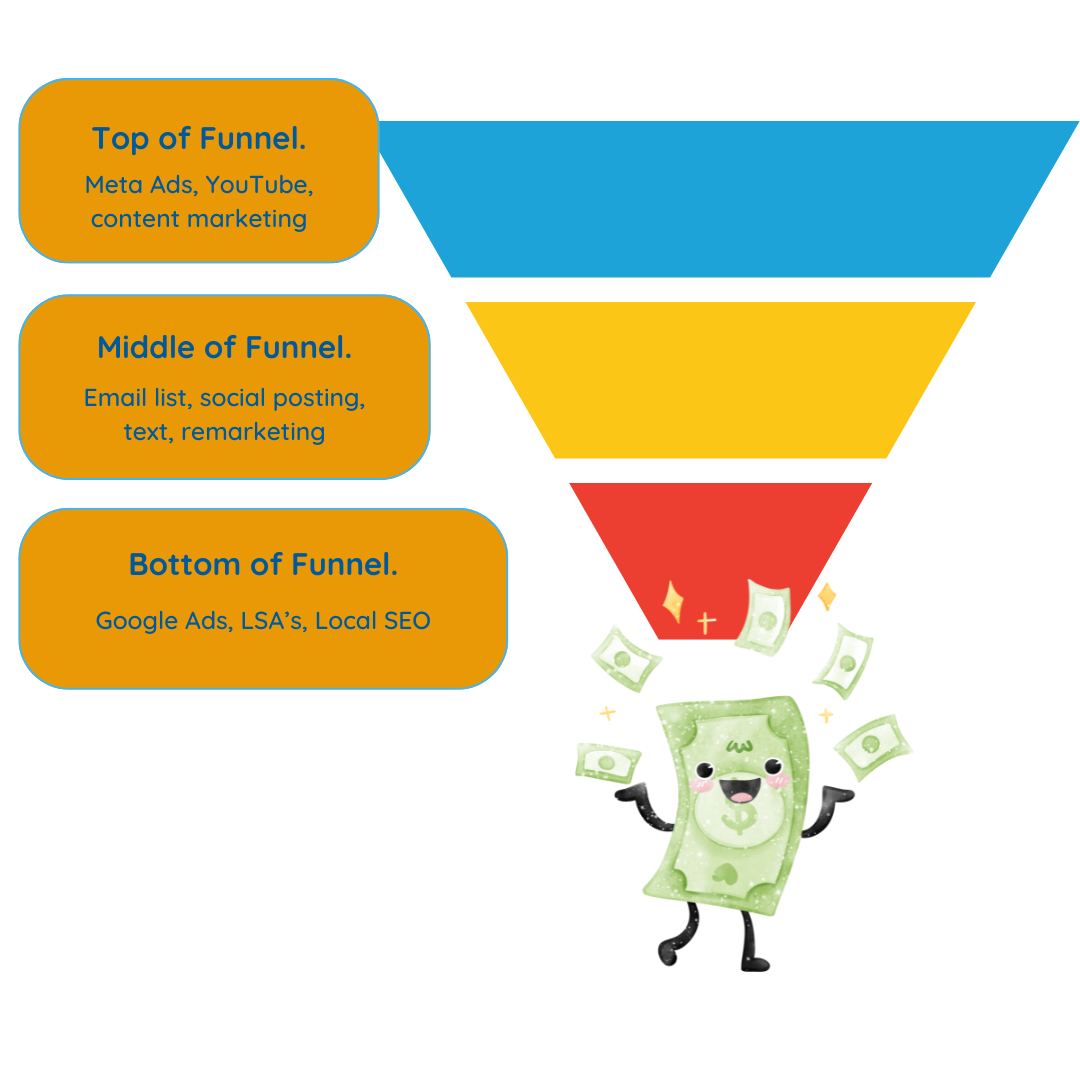
To understand how all these pieces fit together, it helps to look at the bigger picture: the marketing funnel. Every law firm’s potential clients move through a few basic stages before they pick up the phone or fill out a form. Marketers usually call these TOFU, MOFU, and BOFU, short for top, middle, and bottom of the funnel.
Top of Funnel (TOFU)
At the top of the funnel (TOFU), people are just becoming aware of a problem or starting to ask questions. They might search for things like “how to get custody of my kids” or “what happens if I die without a will.” These people are not ready to hire a lawyer yet, but they are valuable because they represent the beginning of a relationship.
This is where Meta Ads, YouTube Ads, and content marketing come in. Educational blog posts, short videos, and social content help your firm show up early in the process and start building familiarity and trust. At this stage, you want to give people something useful, such as a free resource, guide, or checklist, in exchange for their email address. You also want to encourage them to follow your firm on social media.
The goal at the top of the funnel is not to make a sale but to create connection points. Whether it is an email subscription, a social follow, or simply repeated exposure to your helpful content, these are the first touches that make your firm recognizable. Later, when someone is ready to take action, that familiarity becomes a powerful advantage.
Middle of Funnel (MOFU)
In the middle of the funnel (MOFU), people know they will probably need a lawyer but are still weighing their options. They might search for “cost of divorce lawyer” or “should I hire an estate attorney.” At this stage, they are comparing, learning, and narrowing their choices.
This is where your earlier efforts start to pay off. The people who joined your email list or followed you on social media at the top of the funnel are now seeing more of your content. They are receiving educational messages through email, seeing your updates and client success stories on social platforms, and possibly even getting reminders through text or remarketing ads.
The goal at this stage is to stay visible and build trust. You are not pushing for a sale; you are demonstrating expertise, consistency, and reliability. When people in this stage see your name repeatedly across different channels, it reinforces the idea that your firm is established, active, and trustworthy. By the time they are ready to make a decision, they already feel like they know you.
Bottom of Funnel (BOFU)
At the bottom of the funnel (BOFU), people are ready to take action. They are searching for specific, high-intent terms like “divorce lawyer near me” or “estate planning attorney free consultation.” This is where Google Ads, Local SEO, and Local Service Ads (LSAs) all come into play. Each of these channels targets people who are ready to call a lawyer right now. They all do the same essential job, just in slightly different ways.
Google Ads gives you the most control. You can decide which keywords to target, which audiences to focus on, and how much to spend. Local SEO helps your firm appear organically in Google Maps and the local search results, which builds trust and drives leads without paying for each click. LSAs put you at the very top of the results with pay-per-lead pricing, which can work well for visibility and volume, even if the quality of leads varies.
Bottom-of-funnel marketing is the fastest way to start generating leads. If you need calls and form submissions right away, Google Ads and LSAs can start producing results in days, while Local SEO builds momentum over time. What makes these campaigns even more powerful is when people already recognize your name from earlier touchpoints. When someone has seen your videos, read your posts, or received your emails, they are far more likely to choose you when they see your ad or listing in a search result.
The beauty of the funnel is that everything supports everything else. You can absolutely start with bottom-of-funnel campaigns to get leads quickly, then build out your top- and middle-funnel marketing to make those campaigns work even better. When all three stages are running together, your marketing becomes predictable, efficient, and hard for competitors to beat.
The Smart Law Firm Strategy
If you want leads this week, start with Google Ads. It is the fastest and most direct way to start conversations with people who are ready to hire a lawyer now. If you want to lower your cost per lead and build sustainable growth over time, invest in Local SEO. It takes longer to gain traction, but once it does, it delivers steady, lower-cost leads month after month.
These two channels complement each other perfectly. Google Ads drives immediate results while SEO builds momentum for the long term. Local Service Ads can support both, offering more visibility when managed carefully.
When you align all three and connect them with your top- and middle-of-funnel marketing, you create a full system that works together. Google Ads brings in leads quickly, SEO and LSAs strengthen your presence, and your content, social, and email marketing make people more likely to choose you when they are ready to act.
That is the smart law firm marketing strategy: quick traction now, efficient growth later, and a steady stream of qualified leads coming from every stage of the funnel.
Let’s Talk Strategy
If you’d like a forensic look at where your ad dollars are leaking, let’s talk. In one short conversation, we can uncover what is holding back your growth and outline practical ways to fix it.
There is no hard sell, just an honest look at what is working, what is not, and what you can do to start getting better results right away.