
This past weekend, Lane Kiffin returned to Ole Miss as the opposing head coach of LSU, less than a year after leaving Ole Miss to take the LSU job. The reception was predictably hostile, and it immediately reminded me of another Kiffin return that happened five years earlier.
If you don’t follow college football, here’s the background.
Kiffin coached Tennessee for one season in 2009, then abruptly left for USC. Tennessee fans were furious, and he remained one of the most disliked figures in the program’s recent history.
In 2021, Kiffin returned to Knoxville for the first time as an opposing head coach, this time leading Ole Miss against Tennessee at Neyland Stadium.
The game was close and contentious. Late in the fourth quarter, Tennessee was stopped on a controversial fourth-down play. Fans began throwing objects onto the field, including cups, bottles, debris, and, most memorably, a bottle of French’s mustard.
The game was delayed while the field was cleared, and the incident quickly became a national story.
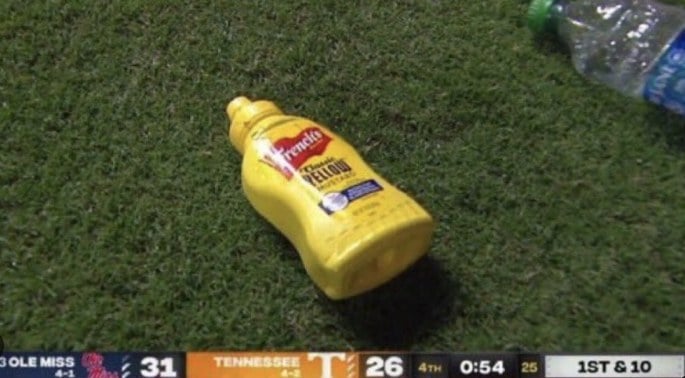
And the story wasn’t simply that some fans had behaved badly.
The incident fit neatly into stereotypes that already existed about Tennessee fans, East Tennesseans, Southerners, and Appalachians. The coverage reduced a huge group of people to the behavior of the people throwing things that night. The mustard bottle became an almost perfect visual shorthand for the story: look at these ridiculous hillbillies throwing condiments onto a football field.
From a public relations standpoint, Tennessee fans had a reputation problem.
More specifically, we had lost control of the narrative.
The national media had a compelling image, a simple story, and a stereotype that made the story easy to understand. Once people have a picture in their heads that seems to confirm what they already believe, simply arguing that the picture is unfair doesn’t usually change much.
You can say most Tennessee fans didn’t throw anything.
You can point out that every fan base has people who behave badly.
You can accuse the national media of stereotyping Southerners.
But you’re still answering someone else’s framing. They control the terms of the conversation.
That is where the marketing story begins.
At the time, I had recently read Donald Miller’s Building a StoryBrand, and one of its central ideas was fresh in my mind: the customer should be the hero of the story.
Tennessee fans were being cast as the villain.
Instead of trying to convince people that they had the wrong villain, what if we could change the story?
Don’t defend the narrative. Change it.
I started thinking about what Tennessee fans could do.
Not what could we say about ourselves. What could we actually do that demonstrated something different?
My first thought was to raise money for charity.
But the choice of charity mattered.
Imagine if we had raised money for a Tennessee fan who had been arrested after the game. That might have rallied some fans, but it wouldn’t have changed the narrative. Critics could have pointed to it as more evidence of Tennessee fans defending bad behavior.
A children’s hospital was different.
Nobody has to like Tennessee fans to believe that helping sick children is good.
You could still think throwing things onto the field was disgraceful. You could still dislike Tennessee. But you couldn’t argue with the fact that those same fans were raising money for sick kids.
We weren’t claiming the stereotype was wrong.
We were creating evidence that didn’t fit the stereotype.
That’s a narrative intervention.
I started looking around and landed on East Tennessee Children’s Hospital. It was local, which mattered. This wasn’t an abstract national charity. It was an institution in the same part of the world that was being mocked.
(The hospital was renamed Dolly Parton Children’s Hospital in 2026. I’m using the name it had at the time, which is the name on the check.)
The hospital also had an official relationship with GoFundMe. If we were going to ask thousands of strangers on the internet for money, I wanted them to know some guy named Brent wasn’t going to disappear with it.
Now we had the action.
We still needed the idea that would make people care.
$1 for every seat in Neyland
We could have tried to raise $100,000.
But $100,000 doesn’t mean anything.
Neyland Stadium had 102,455 seats.
So the goal became $102,455.
One dollar for every seat in Neyland Stadium.
The stadium that had just been shown across the country as the scene of Tennessee fans behaving badly became part of the response.
It was simple. You could understand the whole idea in one sentence.
Jayson Swain heard about the fundraiser and wanted to help. Jayson is a former Tennessee player and was already a major voice in the Vol community. We were connected on Twitter, and he came aboard.
Then Vol fans took over.
Within three days, more than 1,400 people had donated and the fundraiser had passed $48,000. It kept going.
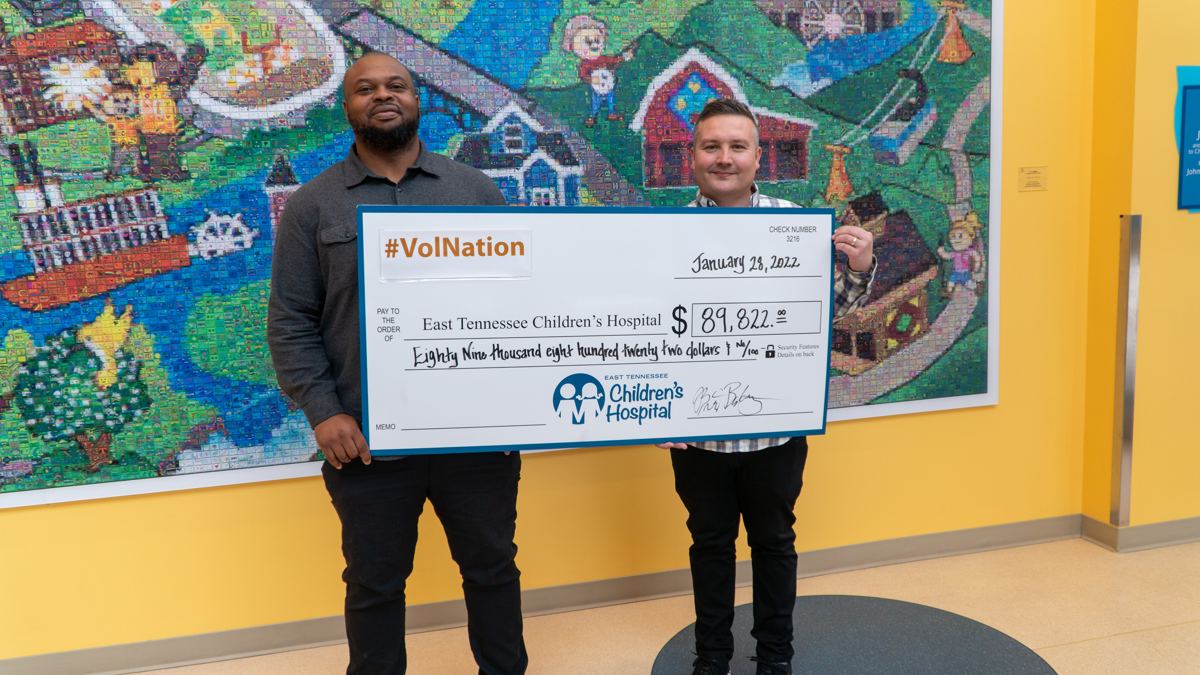
Eventually, we walked into East Tennessee Children’s Hospital with a check for $89,822.
We didn’t reach $102,455.
We raised $89,822 for a children’s hospital.
I’ll take it.
The mustard bottle was still real.
But now the $89,822 was real too.
We had changed the narrative by giving people another fact they couldn’t ignore.
Why did it work?
I’ve thought about this quite a bit since then.
StoryBrand gave me the framework I was consciously using at the time. But I think there was another psychological mechanism involved that I understand better now.
Psychologist Heidi Grant Halvorson writes in No One Understands You and What to Do About It about our tendency to divide the world into “us” and “them.”
When someone is part of our group, their success can feel like our success. Social psychologists call one version of this basking in reflected glory. Robert Cialdini coined the term in a 1976 study that was literally about college football fans. After a win, students said “we won.” After a loss, “they lost.”
Sports fans understand this intuitively.
Nobody says, “The University of Tennessee football team defeated Alabama.”
We beat Alabama.
That “we” mattered here too.
I wasn’t an outside marketer looking for an angry group of people I could exploit.
I was pissed off too.
This was our fan base. Our stadium. People were talking about us.
The message wasn’t:
Look what Brent and Jayson are doing.
It was:
Let’s show them who we are.
And people could participate in that story instead of merely agreeing with it.
Look at the photograph from the eventual check presentation and you’ll see that idea almost literally.
The giant check doesn’t say “The Brent Baltzer Fund.”
Across the top it says:
#VolNation
That’s who the accomplishment belonged to.
The Mustard Bottle Technique
I’ve thought a lot about what happened after that game and whether the basic idea could be repeated.
I think it can, under the right circumstances.
I’m going to call it The Mustard Bottle Technique.
When outsiders impose a negative narrative on a group that overlaps with the people you want to reach, and you authentically belong to that group too, look for an action that lets the group demonstrate something different about itself.
For a law firm, the group might be your city, your region, a university community, a fan base, or another community that genuinely includes both the firm and the people it serves.
The authenticity part matters. You can’t go hunting for somebody else’s outrage because you see a marketing opportunity.
But when something is already happening in a community you belong to, pay attention.
There may be an opportunity to do more than comment on it.
You may be able to change the narrative.
And if you do, the action needs to be hard to argue with. That’s one of the biggest lessons I took from the children’s hospital. We didn’t give people a better argument. We gave them evidence.
That’s the process I think can be repeated.
Notice the moment.
Understand what the community is feeling.
Find an authentic way to act.
Make it simple enough that people can participate.
And give them ownership of what happens.
Pay attention
The larger marketing lesson isn’t that law firms should start looking for controversies so they can launch fundraisers.
It’s that good marketing requires paying attention.
Most businesses in a market are doing roughly the same things as everybody else. The same ads. The same social posts. The same sponsorships. The same ideas.
Then, occasionally, something happens that creates an opportunity nobody planned for.
You can’t put those moments on a marketing calendar.
You can notice them.
And if you’re paying attention, you can sometimes see an idea that everybody else misses.
Five years later, seeing Lane Kiffin return to Ole Miss reminded me of one of those moments.
We couldn’t make the mustard bottle disappear.
So we gave people something else to talk about.
$89,822 for East Tennessee Children’s Hospital.
That’s the Mustard Bottle Technique.